Noticing the world around us

Category: EDCI 336 (Page 2 of 2)

This is a category for the EdTech course. Please add this category in addition to the relevant edtech assignment category(ies).

Inquiry #2: Noticing Sonder

Question for this week: How does noticing other people affect me?

We have all heard the expression, put yourself into someone else’s shoes, but do you ever find yourself realizing how many shoes there are around you? I know it sounds kinda silly, doesn’t it? However, I often find myself realizing that there are so many people all around us, each doing their own thing, living their own lives. There is a word for this: it is called sonder. The dictionary definition of this is ā€œthe feeling one has on realizing that every other individual one sees has a life as full and real as one’s own, in which they are the central character and others, including oneself, have secondary or insignificant roles.ā€ I found myself observing people as I went about my week, and as I am a university student, a lot of my observations were made around other university students. When I ride the bus, there are tons of people, and I mean tons of people; sometimes, there is barely any standing room. However, it is always interesting to notice the little things. Some students who look stressed and are working on last-minute assignments as they board the bus, while others who look so carefree are listening to their favourite songs. I often find myself wondering what their lives are like, what plans do they have to seize the day; is today just like any other day, or did something big happen today? Who is missing someone, who is ecstatic as they’ve landed a dream job?Ā 

This little exercise of noticing isn’t just something that I do and then forget about. I believe it leads me into a more compassionate lifestyle. I think the more I think and notice others, maybe it’s just that little extra bit of humanity we can give back to the world. I think what I have noticed in my life is that our world is quite individualistic. Oftentimes, I even find myself turning on my phone when I am waiting for something or someone, so that I don’t look out of place, or maybe I turn on my headphones to block out the noise of the world when maybe there was someone I could befriend. These things aren’t inherently bad, but I wonder what they do to us if we don’t put them down and start noticing those around us. 

My theory was that if everyone started to notice those around us, whether it’s on the bus, walking downtown, at work, or through campus, maybe we would start to see that everyone deals with their own battles and victories. Maybe our compassion for one another would grow. Maybe we would start talking to strangers, build more community, and see so much value in a stranger. Just a theory, but I feel as though I can see it in my own life, and that sonder is something I will continue to ponder as I learn more about The Art of Noticing.

A photo of people getting onto a busy bus, it is slightly blurred.

Photo by sidorenko on Unsplash

Definition by : SONDER Definition & Meaning | Dictionary.com
Inquiry based schools

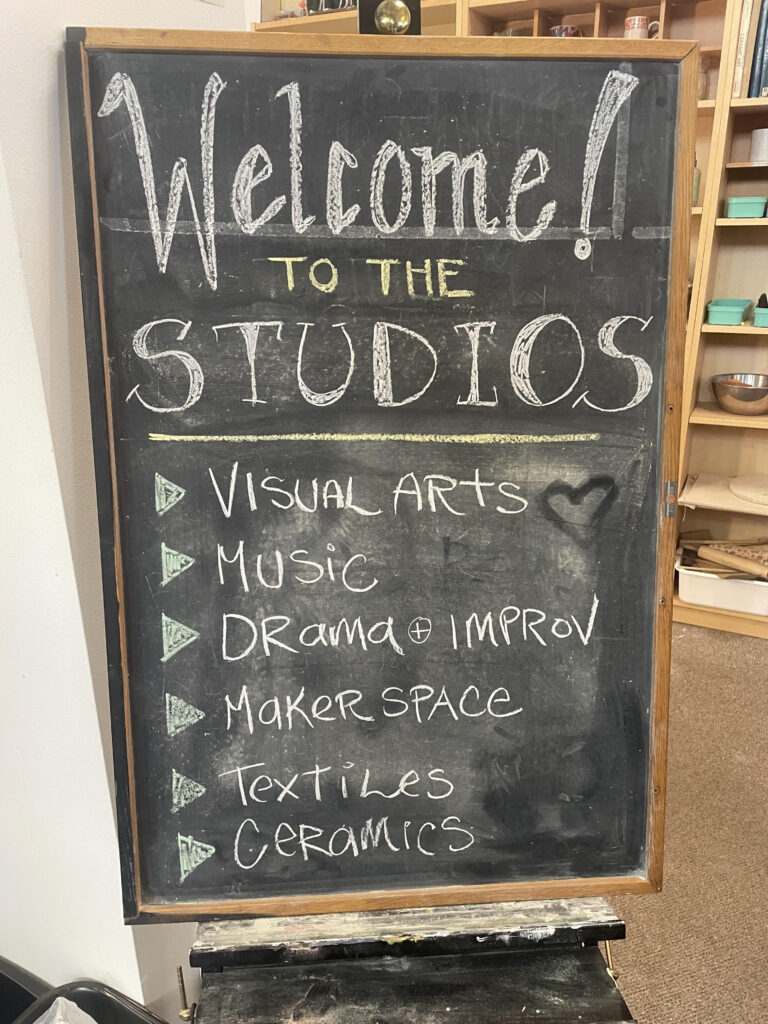
This past Friday, I had the pleasure of visiting a technology and innovation high school in Victoria BC. Although I’m studying to be a an elementary teacher, visiting this high school gave me so much insight into the benefits that inquiry based education can have. In this school, kids were not formatted into neat boxes of attending specific classes to benefit and fit curriculum. Rather, they were given opportunities to study their interests and then teachers would do some work to help the student expand their ideas and interest to go across the curriculum. For example, they were working reading a science fiction novel and they would take apart the science in the novel to see if it was plausible, thus fulfilling their science requirement in an engaging way. They also had every creative persons dream located just downstairs. Students had access to a whole studio where they could work on a multitude of things, such as photography, ceramics, sewing, drama, music and whatever else they wanted to spearhead. This visit to this school has opened my eyes that there isn’t just one path and road to being a teacher. There are many different ways of teaching that aren’t bound by the same traditional modes of learning that I went through my elementary school years learning.

Photo of the Art studio board at pacific school of Innovation and Inquiry. It lists Visual Arts, Music,  Drama / Improv, Makerspace, Textiles, and Ceramics.

Photo by Carlee Cleveland

Pacific School of Innovation & Inquiry

A Thought on Open Education

One of this week’s main concepts and the general overarching theme of this course is the concept of open education. Through the conference call with Valerie Irvine and Cable Green, I have gained more insight into how open education, or specifically Creative Commons, works and is an extremely beneficial resource for educational tools. Green, who works in the United States, spoke about some of the things that had been huge learning blocks to students in post-education, one of them being finances. He mentioned that even something as simple as a $150 chemistry textbook could put them far enough out of pocket to prevent them from continuing their education. He mentioned that through Creative Commons and other resources, they have helped students save thousands of dollars. Green also mentioned how copyright works in open education, he has even used it to publish online with the correct copyright that he needs and wants, allowing it to be published exactly how he wants it to be. I think this tool of open education is an incredible resource for all students and professionals seeking knowledge in an encouraging and empowering way, putting knowledge back in the hands of the everyday person.Ā 

Cable Green On Open Educational Resources

Week 3: More on Open Ed, Citizenship Online, & Inquiry – EDCI 336

Cable Green – EDCI 136 – Digital Literacy

Inquiry #1: A Time to Stop and Look

My question for this week : What does it mean to truly notice something and how does that impact me?

Have you ever stopped to notice how the light shimmers through the trees or how the birds sound in the morning versus in the evening? Do these things really matter, or are they just the mundane aspects of life that are found in our world? There is a concept called The Art of Noticing, first developed by Rob Walker, who wrote a book by the same name. The concept of this art format is to change the patterns or ways you view and interact with this world. There are 5 categories to The Art of Noticing: Looking, Sensing, Going places, Connecting with others, and Being alone. There are many techniques he suggests that can be used to harness this art, yet for my purposes, I would like to play around with this idea of noticing without following specific rules, for what is art without play? Will noticing the little things around me change the way I view or engage with the world? My goal for this blog is to explore the things I’ve noticed throughout the week, no matter how big or small, for the great purpose of this exploration is in the details of the everyday.Ā 

We live in an age where business rules over lives, where we run from one place to the next, catching our breath as we go. This sense of magic over the mundane has somehow seemed to diminish as we grow up.  So, whether it’s through photographs, videos, or simply my writing, I will share with you the things I notice, the things hidden in plain sight. As I explore these things, maybe more childlike wonder will return to me, and I can once again find magic in the mundane. 

I will leave you with this little video of the wind in the tall grass that I took a little while back. It made me think of how lovely it would be to have a picnic here and watch the grass do its dance as it sways back and forth beneath the trees. I encourage you as well to go somewhere and do something that makes you pause and simply notice the world around you. 

Wind blowing through the long grass

Video Taken by Carlee Cleveland On iPhone

Website for more information on The Art of Noticing by Rob Walker

Rob Walker. Rob Walker RSS. (n.d.). https://robwalker.net/noticing/

Most Likely To Succeed

After watching Most Likely to Succeed by Ted Dintersmith, Tony Wagner and Greg Whiteley. In this documentary, I was struck by how the future of education must change. In the past, education has often been a linear track to forming good employees who will go on to work the system of the assembly line or 9-5 style career. Yet, in an innovative technology school where the majority of the film takes place, there is this desire to foster new concepts about how kids should learn. I found it very interesting that much of the learning for students was self-directed and gave them the ability to explore their interests while tying in the traditional elements of learning in an untraditional way. I think that this needs to be the focus of education going forward, especially in a day and age where AI will start to change the way jobs are done. The film Most Likely to Succeed highlights the importance of forming innovative, creative thinkers for the future and how school systems have a responsibility to change.

UVic Libraries Videoshttps://webapp.library.uvic.ca/videos/viewlinks.php?vfn=Most-Likely-To-Succeed-(2015).mp4

(2) Most Likely to Succeed | Official Trailer | – YouTube

Newer posts »