This is my final post for this years Edtech 336 course. This presentation was Exploring the Way AI is involved with and influences k-12 Education and how educators can utilize AI as a productive tool. This presentation was done by Carlee, Racheal, Melody, and Kat.
Category: Weekly Reflections
This is the category to apply to your Weekly Reflection posts from the course.
Well this is it, this is the last post for this blog. As this course comes to an end I have been reflecting on how this blog has affected my life. I think the concept I chose to explore in my blog is really impactful for grounding my life. The Art of Noticing has been extremely beneficial to my every day life. I think my life can get so busy that I don’t notice all the wonderful things that are happening around me. Or, I am often waiting for the next big exciting thing to happen, but I am not often noticing the things that are mundane but equally beautiful. I think throughout this semester, this blog has allowed me to take in the world around me. It started out with trying to pay attention to something that I could write about, but as my blog is now finished I still find myself taking in my surroundings, paying attention to the smells in the air or the noises. It has been a wonderful practice of grounding myself in reality and practicing gratitude for a world that has so much to offer. I think if I were to do this blog again, I would try and find things to talk about that were fit into all the categories of the senses, just as an extra challenge to me. I will recommend this art form to everyone, it is a wonderful way to break away from the daily grind, and really see the magic in the mundane.
In this weeks zoom class we played around with the web format EDcamp. In this format, multiple people could post a thought or a question and then the whole class could have access to it. We then took the questions and complied them into categories in which we then got into small groups to discuss. I could really see the usefulness of this is a form of distance or hybrid education as it gives everyone a chance to contribute to the conversation or ide formation without having to be in person. I also enjoyed how we split into smaller groups to try and tackle our discussion topics. I think it was really great to have a chance to hear everyone speak (or gives those with a quieter voice an opportunity to speak.) Our discussion topic was incorporating play based learning or nature based learning within the learning atmosphere. We were also given 30 minutes to discuss this which could’ve gone sideways but actually resulted in a fruitful discussion where conversation flowed well. After our small groups we got into one big group so we could hear thoughts on the other topics which I feel allowed us to get snippet’s of other interesting topics. As stated before, I think the use of EDcamp like we used today would be really beneficial for online, distance learning.
This was our collaborative brainstorming during our Ed Tech presentation.
Rich McCue v5.0 – My Thoughts on Makerspaces, Technology, & Education…
This week (Week 9) we had guest speaker Cari Wilson who spoke on AI technology implemented in schools. She brought up interesting points, such as the fact that all schools and educators will have to grapple with the fact that kids are exposed to technology and AI from a young age. This could either be amazing for kids to grow and learn with technology or it could be harmful and I think it’s our Job as educators to try and understand and implement safe areas for kids to experiment with and understand the use of AI in the classroom setting as well as their home room setting. I thought it was also important to note that she said teachers will never be replaced by AI and for the most part I agree. I do however think that our roles as teacher will most likely gradually shift into something like a an adult who guide social emotional learning more than academics which can be modeled through the alpha schools that are starting in the US (link below). It will be interesting to see whether school systems such as Alpha will produce well rounded students.
In week 8 Education Technology class we had a guest speaker with Rich McCue who spoke on some of the technology tools we can use in the classroom to equip as better as teachers. This class was a lot of fun for me as it was a lot of experimenting with tools I haven’t previously used. The main things we went over was image editing, Google Gemini and video editing using clip champ. I have had a fair bit of experience editing both photos and videos but I hadn’t engaged at all with Google Gemini. I thought it was really interesting the to play around with it. I gave it a few prompts such as organize the classroom so that everyone is facing forward but in a collaborative sense, and it gave me the image below. I felt that this could be used in a abundant kind of way as it is very versatile for helping come up with ideas and perspectives a teacher possibly hadn’t thought of. I think tools like this are very cool but I am still learning the gray areas of copyright and ethical / environmental responsibility.
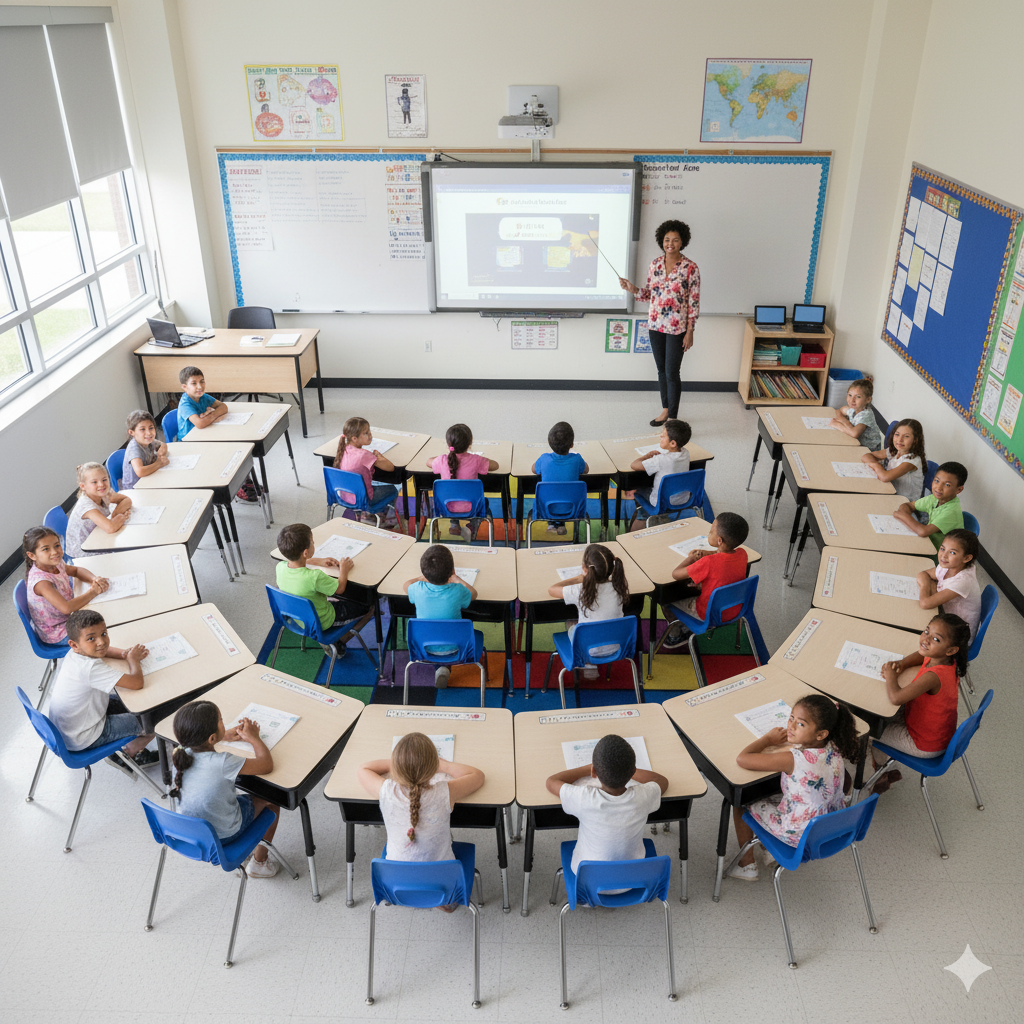
Image created by Google Gemini
Rich McCue v5.0 – My Thoughts on Makerspaces, Technology, & Education…
During week 5 of the education technology class, we presented our ideas for a group inquiry project to each other in our online zoom class. I found the array of topics that each group chose quite interesting as so many of them are topics us as future educators will have to grapple with and try to understand. For example, my group has chosen to tackle the use of AI in classrooms for both the good and the bad. Some other topics by other groups include “How did school going online during COVID affect students’ learning?” and “What are the primary internet safety issues for use in the classroom, and how can they be most effectively taught?” I think it’s really great that we have the freedom to choose some of these topics that are of interest to us. I think some of these things are not only of interest but of worry. I think we as teachers are going to be challenges with teaching the first ever generation that is completely surrounded in technology. There is no point shutting it all out because kids can not escape the technology that is rapidly developing around them. I am looking forward to these presentations as I hope they will educate me or inspire me in my journey to becoming an technology literate teacher that protects and equips her students.
Week 5: Project Preview Presentations; Datafication – EDCI 336
This past Friday, I had the pleasure of visiting a technology and innovation high school in Victoria BC. Although I’m studying to be a an elementary teacher, visiting this high school gave me so much insight into the benefits that inquiry based education can have. In this school, kids were not formatted into neat boxes of attending specific classes to benefit and fit curriculum. Rather, they were given opportunities to study their interests and then teachers would do some work to help the student expand their ideas and interest to go across the curriculum. For example, they were working reading a science fiction novel and they would take apart the science in the novel to see if it was plausible, thus fulfilling their science requirement in an engaging way. They also had every creative persons dream located just downstairs. Students had access to a whole studio where they could work on a multitude of things, such as photography, ceramics, sewing, drama, music and whatever else they wanted to spearhead. This visit to this school has opened my eyes that there isn’t just one path and road to being a teacher. There are many different ways of teaching that aren’t bound by the same traditional modes of learning that I went through my elementary school years learning.
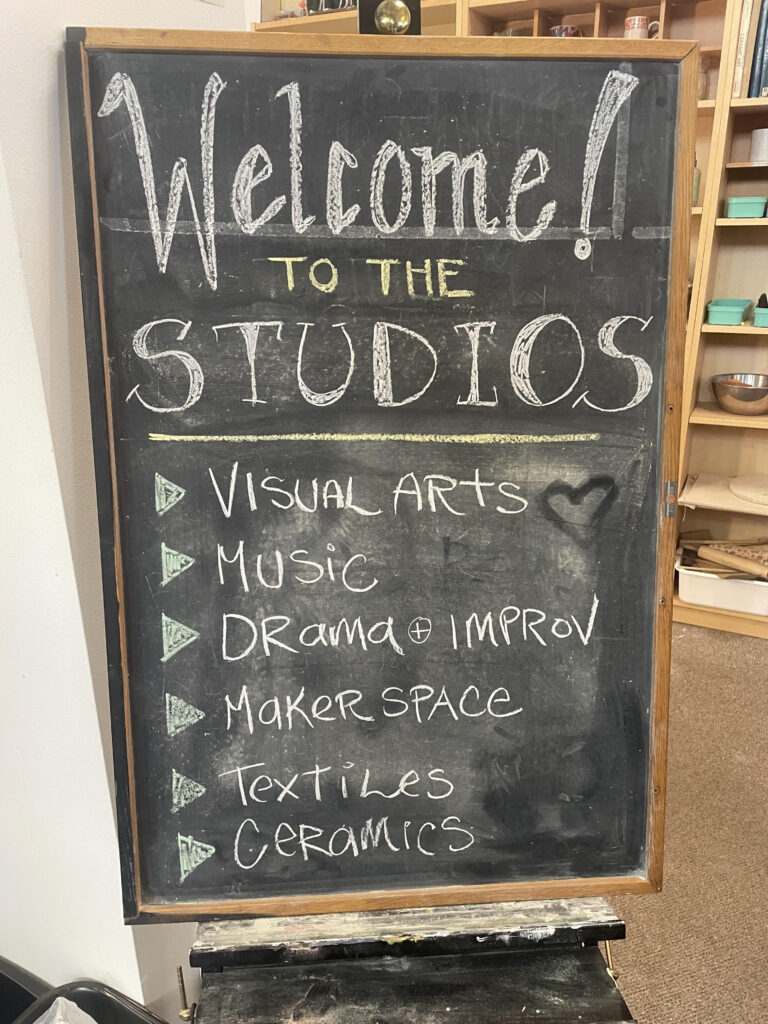
Photo by Carlee Cleveland
One of this week’s main concepts and the general overarching theme of this course is the concept of open education. Through the conference call with Valerie Irvine and Cable Green, I have gained more insight into how open education, or specifically Creative Commons, works and is an extremely beneficial resource for educational tools. Green, who works in the United States, spoke about some of the things that had been huge learning blocks to students in post-education, one of them being finances. He mentioned that even something as simple as a $150 chemistry textbook could put them far enough out of pocket to prevent them from continuing their education. He mentioned that through Creative Commons and other resources, they have helped students save thousands of dollars. Green also mentioned how copyright works in open education, he has even used it to publish online with the correct copyright that he needs and wants, allowing it to be published exactly how he wants it to be. I think this tool of open education is an incredible resource for all students and professionals seeking knowledge in an encouraging and empowering way, putting knowledge back in the hands of the everyday person.
Cable Green On Open Educational Resources
Week 3: More on Open Ed, Citizenship Online, & Inquiry – EDCI 336
After watching Most Likely to Succeed by Ted Dintersmith, Tony Wagner and Greg Whiteley. In this documentary, I was struck by how the future of education must change. In the past, education has often been a linear track to forming good employees who will go on to work the system of the assembly line or 9-5 style career. Yet, in an innovative technology school where the majority of the film takes place, there is this desire to foster new concepts about how kids should learn. I found it very interesting that much of the learning for students was self-directed and gave them the ability to explore their interests while tying in the traditional elements of learning in an untraditional way. I think that this needs to be the focus of education going forward, especially in a day and age where AI will start to change the way jobs are done. The film Most Likely to Succeed highlights the importance of forming innovative, creative thinkers for the future and how school systems have a responsibility to change.
UVic Libraries Videoshttps://webapp.library.uvic.ca/videos/viewlinks.php?vfn=Most-Likely-To-Succeed-(2015).mp4